
Career development is not always about moving into a completely different profession. For many professionals, advancement means becoming better at solving problems, improving processes, contributing to projects, and taking on greater responsibility within their existing field. Process improvement skills can support that development because organizations across many sectors depend on repeatable processes to deliver consistent results.
Lean Six Sigma career advancement can begin with structured training that helps professionals understand how work flows, identify waste, examine variation, investigate problems, and contribute to improvement. Through RPM Academy, Lean Six Sigma Coach provides training aligned with the International Lean Six Sigma Institute, with learning pathways designed for different levels of responsibility.
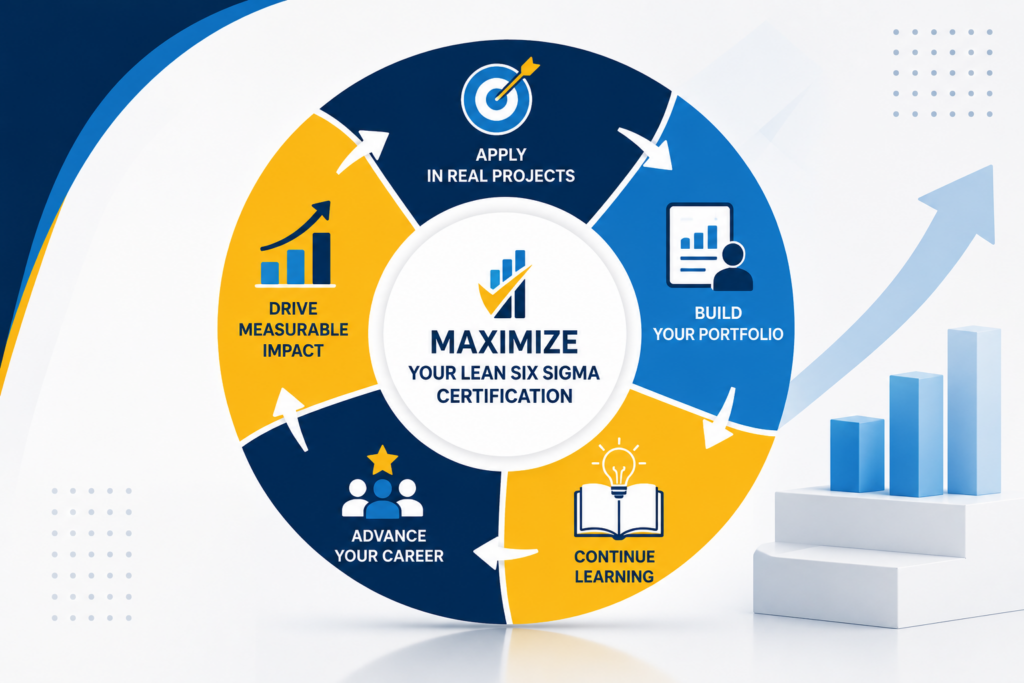
Training leads to a Certificate of Completion. Certification is a separate validation process available for Yellow Belt, Green Belt, and Black Belt. It requires completing the required courses, passing an exam, and submitting practical application evidence. White Belt and Champion are Certificate programs only. Understanding this distinction helps professionals choose development based on the capabilities they want to build and validate.
People Also Ask
How can Lean Six Sigma help with career advancement?
Lean Six Sigma training develops structured process improvement capabilities that professionals can apply across different roles and industries. More advanced training can support development toward project leadership and broader improvement responsibilities.
What are the benefits of becoming a Lean Six Sigma certified professional?
For Yellow Belt, Green Belt, and Black Belt, certification separately validates applied capability after learners complete the required courses, pass an exam, and submit evidence of practical application. Training itself develops the knowledge and skills.
Do I need to complete every Lean Six Sigma Belt in order?
No. Learners are not required to complete every preceding Belt before selecting a more advanced program because relevant foundational concepts are incorporated into the learning pathway.
What Certification Signals to Employers
Professional credentials can provide useful information, but it is important to understand exactly what a Lean Six Sigma credential represents.
Completing training demonstrates that a learner has completed the applicable educational program and results in a Certificate of Completion. The training itself is where professionals develop their Lean Six Sigma knowledge and process improvement capabilities.
Certification goes further at applicable belt levels.
Yellow Belt, Green Belt, and Black Belt certification separately validates applied capability. To earn certification, learners must complete the required courses, pass an exam, and submit evidence of practical application.
This distinction can give employers a clearer understanding of what a professional has completed.
A Certificate of Completion confirms completion of training. Certification indicates that the learner has also met separate requirements to validate applied capability.
The benefits of a Lean Six Sigma certified professional should therefore not be reduced to simply having another line on a resume. The more meaningful value is the ability to demonstrate structured learning together with validated application at applicable belt levels.
The capabilities themselves can also become increasingly relevant as responsibilities expand.
An employee may begin by understanding processes and identifying improvement opportunities. Later, the same professional may participate in improvement activities, take responsibility for projects, work across departments, or support broader organizational improvement.
Lean Six Sigma development can provide a structured pathway for building those capabilities progressively.
How the Skills Transfer Across Sectors
One reason Lean Six Sigma skills can support professional development is that process improvement is not limited to a single type of organization.
Every industry has processes.
Manufacturing organizations manage production, quality, inventory, maintenance, and supply processes. Healthcare organizations coordinate administrative and service processes. Government agencies manage applications, approvals, reporting, and public services. Logistics organizations depend on reliable transportation, warehousing, ordering, and distribution processes.
Universities coordinate admissions, registrations, scheduling, research administration, procurement, and other academic and administrative workflows. IT teams manage incidents, service requests, system changes, and technology support. Financial services organizations depend on repeatable processes for applications, documentation, approvals, transactions, and customer support.
The specific work changes from one environment to another, but professionals can still encounter similar improvement questions.
Where is time being lost?
Which activities add value?
Where does variation occur?
Why does a recurring problem continue?
How can a process become more consistent?
What information should be considered before changing the process?
Lean helps professionals examine value, waste, and process flow. Six Sigma provides structured approaches for understanding variation, process performance, and causes of problems. Lean Six Sigma combines these perspectives to provide a broader process improvement framework.
This transferability can support career development because the professional is developing a way of approaching processes rather than learning only how to perform one narrowly defined task.
The application will differ by sector, role, and organization. However, the ability to understand a process, investigate a problem systematically, and contribute to improvement can remain relevant across different working environments.
What Our Learners Have Said About Career Impact
Career impact should not be measured only by whether someone immediately receives a new job title after completing a course.
Professional development can also show up in the responsibilities someone is prepared to take on, how they approach workplace problems, and their ability to participate in improvement activities with greater structure.
For learners, this makes practical application particularly important.
Someone may begin Lean Six Sigma training because they want a better understanding of improvement terminology. As their learning progresses, they may become better able to recognize process issues, discuss potential causes, participate in improvement activities, or take responsibility for more structured projects.
The appropriate level depends on the learner’s role and goals.
White Belt provides foundational awareness for professionals who need an introduction to Lean Six Sigma concepts.
Yellow Belt develops greater capability for participating in improvement activities.
Green Belt develops stronger process improvement and project leadership capability.
Black Belt develops more advanced analytical, improvement, and leadership capability.
Champion training helps leaders understand how to support and align improvement activities within an organization.
This progression matters for Lean Six Sigma career advancement because development does not have to happen in one large step. Professionals can select training that reflects their current responsibilities and the capabilities they want to develop next.
Career outcomes will naturally differ among learners. Training or certification should not be treated as a guarantee of a promotion, new position, or specific career outcome. Its practical value comes from developing and, where applicable, validating capabilities that professionals can apply within their work.
Building a Long-Term Development Path From Belt to Champion
Lean Six Sigma learning can support different stages of professional development rather than requiring every learner to follow one identical sequence.
White Belt can provide a starting point for professionals seeking foundational awareness. Completion leads to the Certificate in Lean Six Sigma White Belt.
Yellow Belt develops more practical participation capabilities. Completing training earns a Certificate of Completion, while Yellow Belt certification is available separately for learners who complete the required courses, pass an exam, and provide evidence of practical application.
Green Belt suits professionals who want to build stronger capabilities in structured process improvement and project leadership. Training leads to a Certificate of Completion. Green Belt certification is a separate step that validates applied capability after the applicable requirements are satisfied.
Black Belt develops advanced improvement, analytical, and leadership capabilities for professionals who want to take on more complex improvement responsibilities. Black Belt training also results in a Certificate of Completion, with separate certification available after completing the required courses, passing an exam, and submitting evidence of practical application.
Champion training serves a different purpose. It focuses on the leadership perspective needed to support, align, and enable improvement activities across an organization. Completion leads to the Certificate in Lean Six Sigma Champion. Champion does not have a separate certification process.
Professionals are not required to complete every preceding belt before selecting a more advanced program. Relevant foundational concepts are incorporated into the learning pathway, allowing learners to choose training according to their existing experience, responsibilities, and development goals.
This flexibility can make the pathway useful at different career stages.
A frontline employee may want stronger process awareness. A team member may want to participate more effectively in improvement activities. A manager may need project leadership capability. A more experienced improvement professional may need advanced analytical and leadership development. An executive or sponsor may need Champion-level understanding to support improvement at an organizational level.
The benefits of Lean Six Sigma certification are therefore most relevant when the certification matches the professional’s actual role and objectives. Pursue certification to validate applied capability rather than treat it as an automatic next step for every learner.
Build Capabilities That Can Grow With Your Career
Career advancement depends on many factors, including experience, performance, responsibilities, organizational needs, and professional development. Lean Six Sigma training does not guarantee a promotion or a particular career outcome. Still, it can provide a structured way to develop capabilities that become useful as professionals take on greater responsibility.
The progression can begin with understanding processes and improvement concepts, then move toward participating in improvement activities, leading projects, handling more advanced improvement responsibilities, or supporting improvement from a leadership perspective.
Just as importantly, professionals can select a pathway that reflects where they are now rather than following a rigid sequence.
Training develops the knowledge and capability and leads to a Certificate of Completion. Yellow Belt, Green Belt, and Black Belt learners can separately pursue certification to validate applied capability by completing the required courses, passing an exam, and submitting practical application evidence. White Belt and Champion remain Certificate programs only.
For professionals considering Lean Six Sigma career advancement, the most useful question is not simply which belt looks strongest on a resume. It is which level of learning supports the responsibilities they want to handle next.
Enroll in the appropriate program with Lean Six Sigma Coach through RPM Academy to develop process improvement capabilities that can support your professional development across industries.